
Google’s own privacy notice for Gemini tells users: “Please don’t enter confidential information that you wouldn’t want a reviewer to see…”
ChatGPT has reviewers too. In September, 404 Media reported that OpenAI has hired hundreds of outside contractors to read and rate real ChatGPT conversations. OpenAI says it tries to remove personal information first.
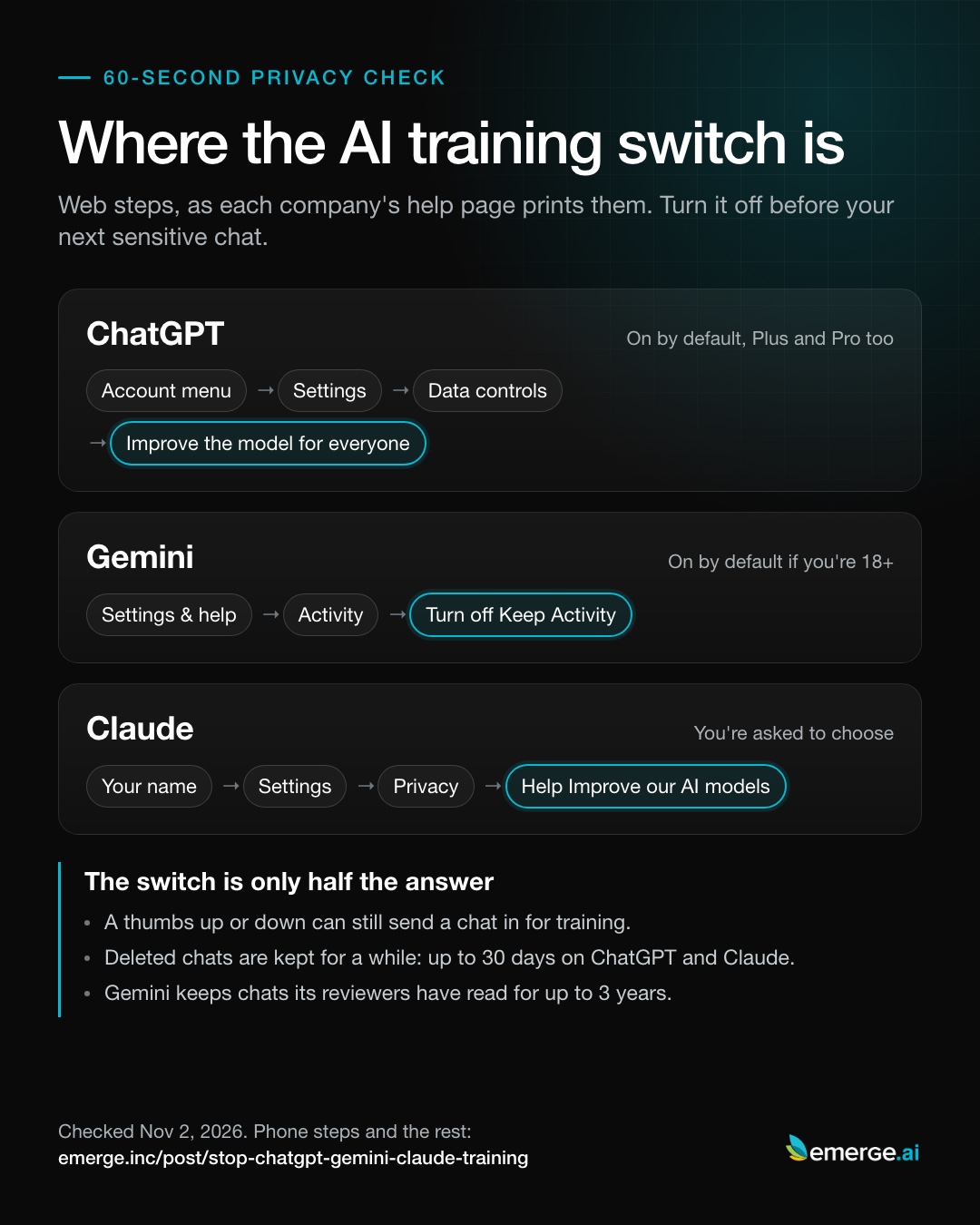
The short answer: ChatGPT and Gemini train on your chats unless you turn it off, and Claude asks you to choose. Here’s where each switch is. It takes about a minute.
Checked on November 2, 2026, on each company’s help page. These settings change often, so follow the links before you rely on them.
The 60-second check
ChatGPT: on by default, including Plus and Pro
- On the web, open your account menu, then Settings → Data controls. In the phone app, open the sidebar and tap your profile icon, then Data controls.
- Turn off Improve the model for everyone, then select Done.
Gemini: on by default if you’re 18 or over
- On gemini.google.com, open Settings & help → Activity. In the app, tap Menu, then your profile picture → Gemini Apps Activity.
- Near the top, select On, then Turn off (or Turn off and delete activity). Google calls the setting Keep Activity.
Claude: you’re asked to choose
- Select your name, then Settings → Privacy.
- Turn off the toggle under Help Improve our AI models. Anthropic doesn’t say which way it starts, but coverage of its 2025 change, including Tom’s Guide, reported the choice arrived with training already on.
Free to share: the one-page cheat sheet.
In all three apps, a thumbs up or down can send the chat in for training, even with the switch off. On anything sensitive, skip the feedback buttons.
Locking a chat doesn’t change any of this. ChatGPT’s new Locked Chats, rolling out since October 20, hide chats on your screen, but OpenAI’s help page says locking doesn’t change the training setting.
We make Emerge.ai. Think of it like a VPN for AI. You use the leading AI models through Emerge.ai, not separate accounts with each AI company, and the same questions apply to us. More on that below.
The switch is only half the answer
Turning training off answers one question: will the company learn from what you typed? Two more decide what happens to your chats. How long are they kept? And who else gets to see or use them?
| Personal plans | Trains on your chats? | What the company says it keeps | Ads |
|---|---|---|---|
| ChatGPT (Free, Go, Plus, Pro) | Yes, unless you turn it off | Deleted chats: up to 30 days (longer under a legal hold, as in 2025) | On Free and Go, matched to what you chat about |
| Gemini (personal Google account) | Yes, while Keep Activity is on | Keep Activity off: 72 hours. Chats read by human reviewers: up to 3 years | Google says chats aren’t used for ads today |
| Claude (Free, Pro, Max, Ultra) | You’re asked. In 2025 it started on. Check yours | Deleted chats: 30 days. Training on: up to 5 years | None |
Business plans work differently. OpenAI and Anthropic keep business and API data out of training by default, and Google says work and school accounts follow different terms. If you use these tools for work, check which plan you’re actually on.
Turning training off doesn’t reach backwards
In May 2025, a federal judge ordered OpenAI to keep ChatGPT conversations it would normally delete, including chats users had deleted themselves. A ruling that October ended the order for new chats. The chats already kept stayed kept.
No setting a user could flip made any difference. The same goes for training. On ChatGPT, switching off “Improve the model for everyone” applies to new conversations, not old ones. On Claude, Anthropic says data already used for training stays in the models trained on it.
“Won’t train” is not the same as “won’t keep”
Gemini makes the gap easy to see. With Keep Activity off, nothing goes into your history, but Google still keeps chats for 72 hours to run the service. Chats that human reviewers have already read are kept for up to three years, and deleting your activity doesn’t delete them.
Temporary chats follow the same logic. Gemini’s are kept for 72 hours. ChatGPT’s Temporary Chat isn’t used for training, and OpenAI says it may keep a copy for up to 30 days.
Who else sees your chats
People, sometimes. That’s why Google’s warning names reviewers. OpenAI’s own FAQ says, “Please don’t share any sensitive information in your conversations.” Anthropic recommends being thoughtful about sharing highly sensitive details.
Ads are another use. OpenAI says advertisers get no access to your chats, but the ads in ChatGPT’s Free and Go plans are matched to what you talk about. You can turn off ad personalization, and OpenAI says it shows no ads to under-18s or next to health, mental-health or political chats. Plus, Pro and the business plans don’t show ads.
Sharing makes a copy too. In October, Meta paused chat sharing in its Muse AI after researchers found about 6,800 shared chats findable online, including a small-business loan application, Engadget reported.
Three questions to ask any AI app
- Will it train on my chats, and where is the switch?
- How long does it keep chats after I delete them, with the switch on and off?
- Who else can see or use them: reviewers, advertisers, anyone with a share link?
Count your accounts too. Every extra AI app is another place your chats live, and another set of answers to check.
What else people ask
Does ChatGPT’s voice mode have its own training switch?
Yes. OpenAI says voice mode has a training control separate from “Improve the model for everyone”, so turn both off.
Is there another way to opt out of ChatGPT training?
Yes. OpenAI’s Privacy Portal takes a “Do not train on my content” request, and OpenAI says either option is enough.
Are Claude’s incognito chats used for training?
No. Anthropic says incognito chats are not used for training.
How long does Gemini keep your activity if you leave it on?
By default, Google auto-deletes it after 18 months. You can change it to 3 or 36 months, or turn auto-delete off.
What we couldn’t confirm
Anthropic’s help pages don’t say which way Claude’s training switch starts, so that comes from coverage of the 2025 change. OpenAI’s help pages still describe ads in ChatGPT as a test, though they now run in 89 countries. If either changes, we’ll update this page.
Where Emerge.ai fits
Emerge.ai is a privacy-forward AI platform, a VPN for AI. You use the leading AI models through Emerge.ai, not separate accounts with each AI company, so there’s one place to check instead of three apps and three switches.
Data is never used for training.
You can also choose Emerge.ai’s own private models: models Emerge.ai hosts itself, alongside the leading AI labs’ models. Paid plans add two more layers of control:
- Emerge.ai Lockdown Mode locks a Cloud to Emerge.ai-approved models.
- Download AI models in the desktop app and run them on your own computer.
It works on the web, desktop, iPhone and Android. How long we keep your data, and who we share it with, is in our privacy policy. Ask us the same three questions, then start free.
Sources
- Google, Gemini Apps Privacy Hub and Manage & delete your activity in Gemini Apps, checked November 2, 2026.
- OpenAI, Data controls in ChatGPT, How your data is used to improve model performance, Chat and file retention in ChatGPT, Temporary chat in ChatGPT, Using Locked Chats in ChatGPT and What is ChatGPT?, checked November 2, 2026.
- OpenAI, Privacy Portal, checked November 2, 2026.
- OpenAI, Ads in ChatGPT, checked November 2, 2026, and ChatGPT Ads expands to 26 new countries, October 21, 2026.
- Anthropic, How do I change my model improvement privacy settings?, Is my data used for model training?, How long do you store my data?, Who can view my conversations? and What is the Ultra plan?, checked November 2, 2026.
- Anthropic, Updates to our consumer terms, August 28, 2025.
- Anthropic, Claude is a space to think, February 4, 2026.
- Tom’s Guide, Your Claude chats are being used to train AI: here’s how to opt out, October 1, 2025.
- 404 Media, Inside ‘Project Lily’: The Humans Reading Your ChatGPT Chats, September 14, 2026.
- TechCrunch, ChatGPT now lets you lock your chats, October 20, 2026.
- Engadget, Meta suspends Muse chats sharing feature after it left private details exposed, October 20, 2026.
- Engadget, OpenAI no longer has to preserve all of its ChatGPT data, with some exceptions, October 2025.
- Business Today, OpenAI is testing ads in ChatGPT on Free and Go, February 10, 2026.