
Why You Should Use Different AI Models for Different Needs
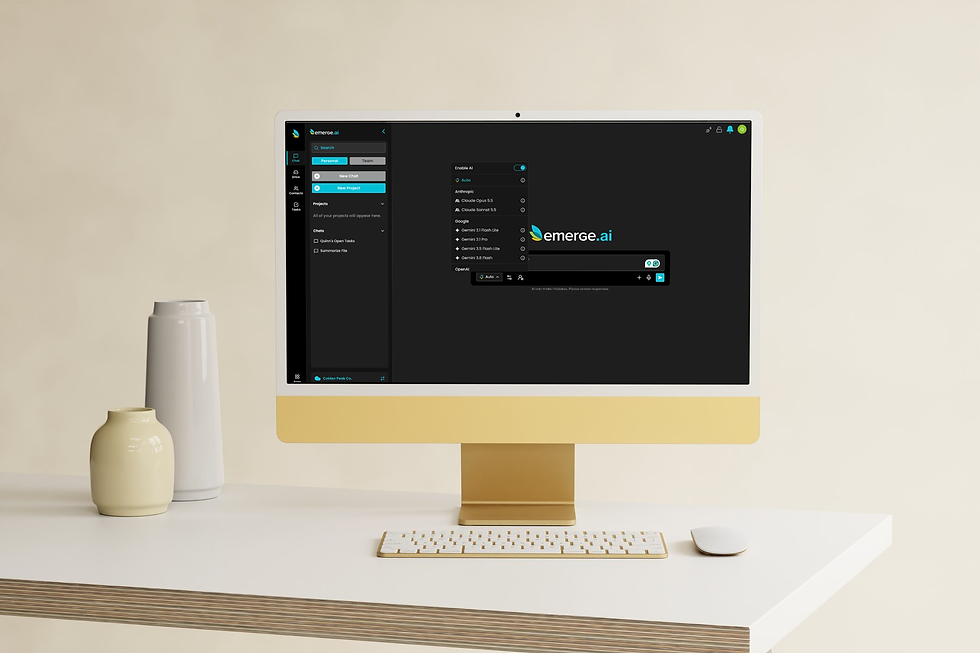
Three flagship AI models launched in three days. Does your team need all of them?
Anthropic released Claude Sonnet 5.5 on September 28. OpenAI released GPT-6.1 Sol on September 29. Google announced Gemini 4 Argon on September 30. Then OpenAI said it wouldn't release GPT-6.1 Astra, a model many expected in October, after internal safety tests.
If your company has built its AI strategy around one model, a week like that can feel like a lot of change. It doesn't have to. The smarter move is to stop looking for one winner and use the right model for each job.
The "One Best Model" Idea Is Fading
The market is already moving this way. F5 reports that organizations now use an average of seven AI models, and 52% chain or orchestrate several together. A LangChain survey of 1,300 professionals found that teams route work by complexity, cost, and speed. Databricks says more than 80% of its customers use multiple models.
Investors are making the same argument. Alex Atallah of OpenRouter told a16z the enterprise future won't be "one model that does everything." Perplexity now pitches itself as a "meta-router" that sends each subtask to the best model from a pool of about 20.
The trade press has a name for it: "modelmaxxing," which means routing every task to the most cost-efficient model available.
Three Reasons Different Tasks Need Different Models
1. Cost: you shouldn't pay flagship prices for routine work
Prices vary a lot between models. Anthropic's Opus 5.5 costs $4 per million input tokens and $20 per million output tokens. Sonnet 5.5 costs $2 and $10. Anthropic says Sonnet is more than 30% faster and lands about two points behind Opus on occupational benchmarks. OpenAI says GPT-6.1 Sol comes close to its GPT-6 Astra flagship at one-fifth the price. GPT-6 Astra is listed at $10 and $50.
Many companies now handle volume work, such as drafts, summaries, and routine Q&A, with lower-cost models. They save the most powerful and most expensive models for complex reasoning and planning.
2. Performance: models have different strengths
Google's own tests put Gemini 4 Argon first on 12 of 18 benchmarks. Independent testing puts it level with GPT-6 Astra and behind Claude Opus 5.5. Some models are better at long documents, some at speed, and some at deep research. The leaderboard also changes every few weeks. The best model this month may not be best next quarter.
3. Risk: relying on one provider creates a single point of failure
Analysts call this model concentration risk. If a model is withdrawn, repriced, restricted, or goes offline, every workflow that depends on it stops too.
Privacy is part of the risk. Reporting this week describes executives worried that using frontier providers' models could expose their "secret sauce." Anthropic's mandatory 30-day chat retention policy for its most powerful models led some firms, including Booz Allen, to restrict their teams' use of it. Microsoft CEO Satya Nadella and Palantir CEO Alex Karp have both warned companies about relying on frontier providers' models. Many companies are now choosing a hybrid approach that mixes closed and open models.
The Hidden Cost of Making People Choose
Variety brings its own problem when it isn't managed. Employees who can't get the tools they want will find their own.
49% of workers use AI tools their employer hasn't sanctioned (BlackFog).
79% of IT leaders have encountered unauthorized AI applications or agents (Nutanix).
88% of employees who have an employer-provided AI tool also use a personal one for work (Gartner, via Deel).
Breaches at organizations with heavy shadow AI use cost about $670,000 more on average (IBM, via Deel).
Banning these tools doesn't work. Security leaders keep giving the same advice: give people an approved option that's as good as what they'd find on their own.
How Emerge.ai Handles AI Choice
Emerge.ai gives your team model choice inside a private, business-ready workspace:
Private, Premium, and Frontier models in one interface. Your team doesn't have to juggle separate subscriptions with separate providers.
Auto Selector. It pairs each task with the most relevant and cost-effective model, so your team doesn't need to know which model is which. It's available on Individual and Business plans.
No vendor lock-in. Your work isn't tied to one provider's roadmap, pricing, or product decisions.
Privacy built in. Lockdown Mode and Anti-Training guarantees keep your data yours.
Connected workflows. Link your chats to Google Drive, Teams, HubSpot, and OneDrive, so your team doesn't switch platforms.
Always-on access. Emerge Private Models and local options keep people productive when token limits or connectivity get in the way.
Pricing that fits a business. You get one subscription for the whole team, with no per-seat licensing. You also get full usage visibility and only pay for what you need.
In short, you get enterprise-grade privacy and choice without enterprise pricing.
What Business Leaders Can Do Now
List where AI is used today. Include the tools your team uses without approval.
Match tasks to needs. Ask which work needs top-tier reasoning and which just needs fast, affordable output.
Avoid depending on one provider. Pick a platform that lets you switch as the market changes.
Offer an approved tool people want to use. That's the best way to reduce shadow AI.
The Bottom Line
The AI model race will keep speeding up, and you can't predict who will lead next quarter. A platform that gives you choice, privacy, and cost control will serve your team better than a bet on any one model.
Explore Emerge.ai Business Plans to give your whole team the right AI for every task, in one private workspace.
AI Designed for Business
Sources used
Model launches and pricing: Silicon AI News model tracker; Pandromeda; Augusto Digital (Monthly LLM News, Oct 2026); Magai
Multi-model adoption: The AI World Keeps Shifting: Modelmaxxing Is Out and Multi-Model Usage Is In (inkl, Oct 2); StartupHub.ai (a16z); Forkast (Perplexity)
Privacy, lock-in, and concentration risk: Yahoo Finance (Oct 5); TechTarget (Oct 5); UD.com.hk (Sept 30)
Shadow AI: BlackFog; Nutanix; Deel (citing Gartner and IBM)


